Cafe owners rarely complain about how a chair looks. They complain when the back starts to wobble, when the seat is stained after a month, or when the chairs won't stack at closing time. Most of that can be spotted on a sample, before anyone pays a deposit.
Below is what we'd look at on any cafe chair, ours or another factory's, before signing off a wholesale order for a UK or EU customer.

Summary
Cafe Chairs at a Glance
The key points, before the detail.
| Item | Short answer |
|---|---|
| Main job | Short stays, constant movement and daily cleaning |
| Frame options | Metal with welded joints and a coating, or solid wood. Check mixed-material models closely. |
| Seat options | Hard seat (quickest to wipe) or upholstered (more comfortable for longer stays) |
| Layout checks | Seat height against your tables, stackability and chair weight |
| Standard to ask about | EN 16139 test report for the exact model you are buying |
| EU wood rules | Wood-frame chairs should be treated as in scope of the EUDR from 30 December 2026. Check each model. |
| MOQ | Dining chairs 100 pcs; tables and coffee tables 50 pcs |
| Production lead time | 45 to 60 days |
| Payment | 30% T/T deposit, balance against a copy of the BL within 10 days |
| Samples and response | Samples available; enquiries answered within 24 hours |
We confirm the MOQ for each model in the quotation. EUDR dates have moved before, so check them with your customs broker.
Use Case
What a Cafe Chair Must Do
How a coffee shop uses its chairs, and why that changes the spec.
Short stays, constant movement
In a coffee shop the same chair gets plenty of different people in a morning. It gets pulled out, pushed back, used as a bag hook and dragged over to another table when a group walks in. That handling is often what loosens joints and wears down leg ends.
Cleaning every day
Seats get wiped as often as tables, and floors get mopped around the legs. Crumbs collect in the gap between seat and back, so a design without that gap is easier for staff to keep clean.
Matching the chair to the venue
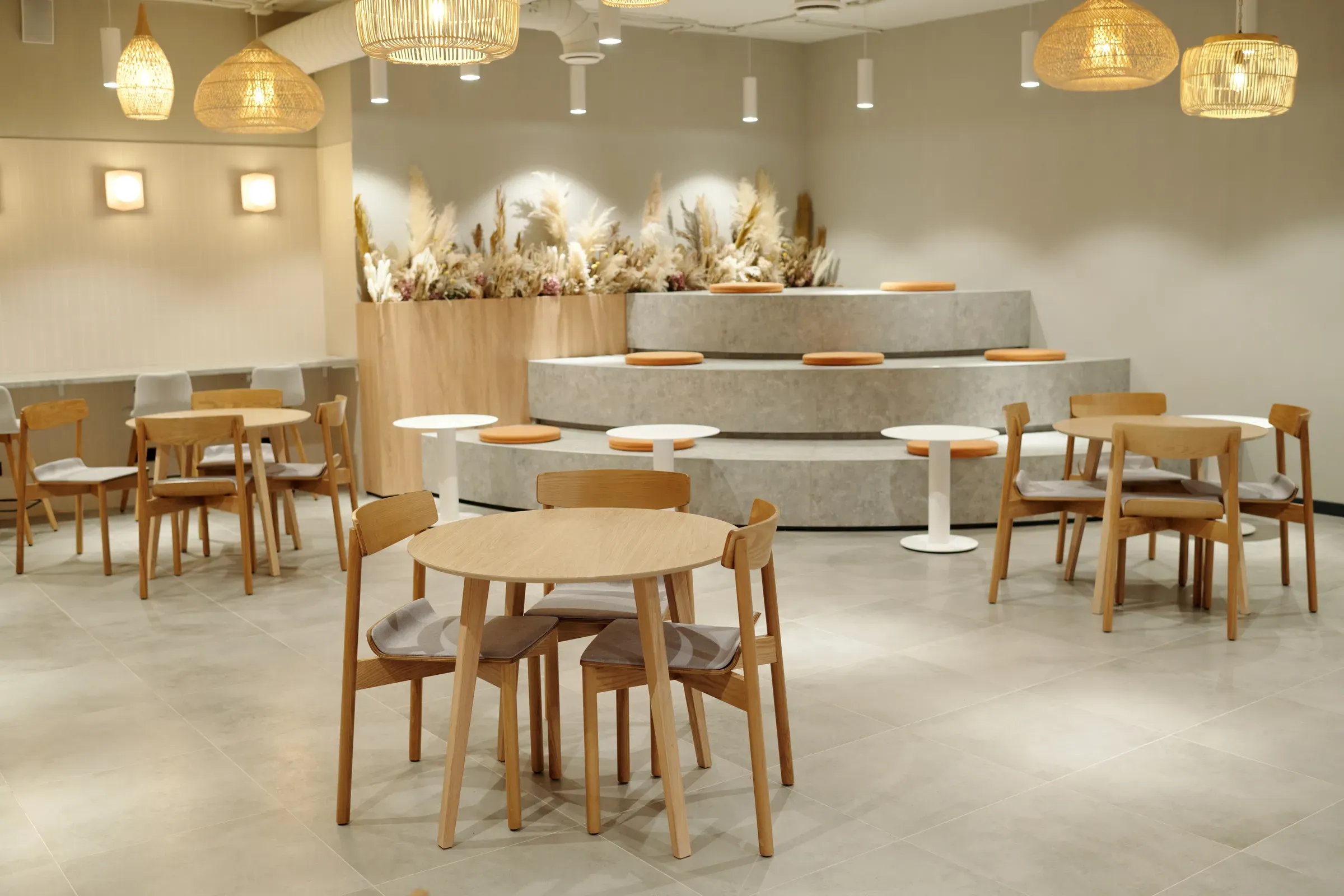
A takeaway coffee bar, a bakery that does lunch and a hotel lounge shouldn't end up with the same chair. Before you send a brief to a factory, ask your customer how long people usually sit, whether chairs go up on the tables at night and whether they ever get moved out for events.
Construction
Frame and Material
Metal or wood, and what to look at in each.
Metal frames
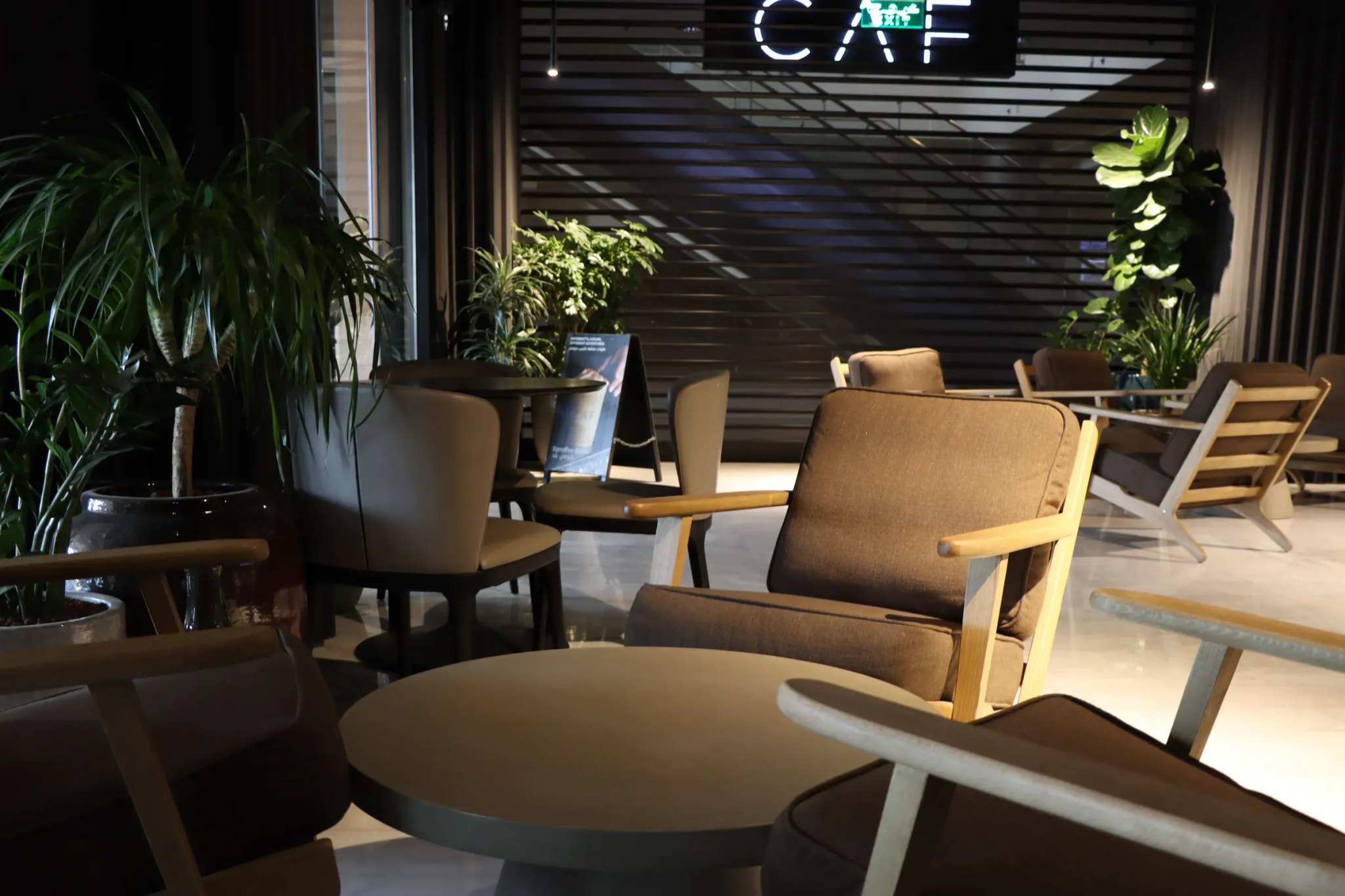
Metal works well in small cafes because the legs can be thin without being weak. Ask whether the joints are welded and how the legs meet the seat frame. On the sample, run a finger along the leg ends and edges, where a coating such as powder coat tends to chip first.
Solid wood frames
Wood gives a warmer look, and a lot of cafes want that. The weak point is usually the joint. If a joint relies on glue or staples alone, ask how it's reinforced, and check the lacquer on the sample the same way you'd check a metal finish.
Mixed-material chairs
Plenty of cafe chairs have a metal frame and a plywood seat. It's a sound design, but for EU buyers it matters under the EUDR, because plywood and other wood-based parts can bring the chair into scope. Ask the factory to list every wooden or wood-based part on each model.
Leg ends and floor protection
Glides and felt pads protect the floor and keep the noise down. They also wear out first, so ask whether staff can replace them easily.
Seat and Finish
Seat, Comfort and Cleaning
Hard seat or upholstered, and how each one cleans.
Hard seat or upholstered
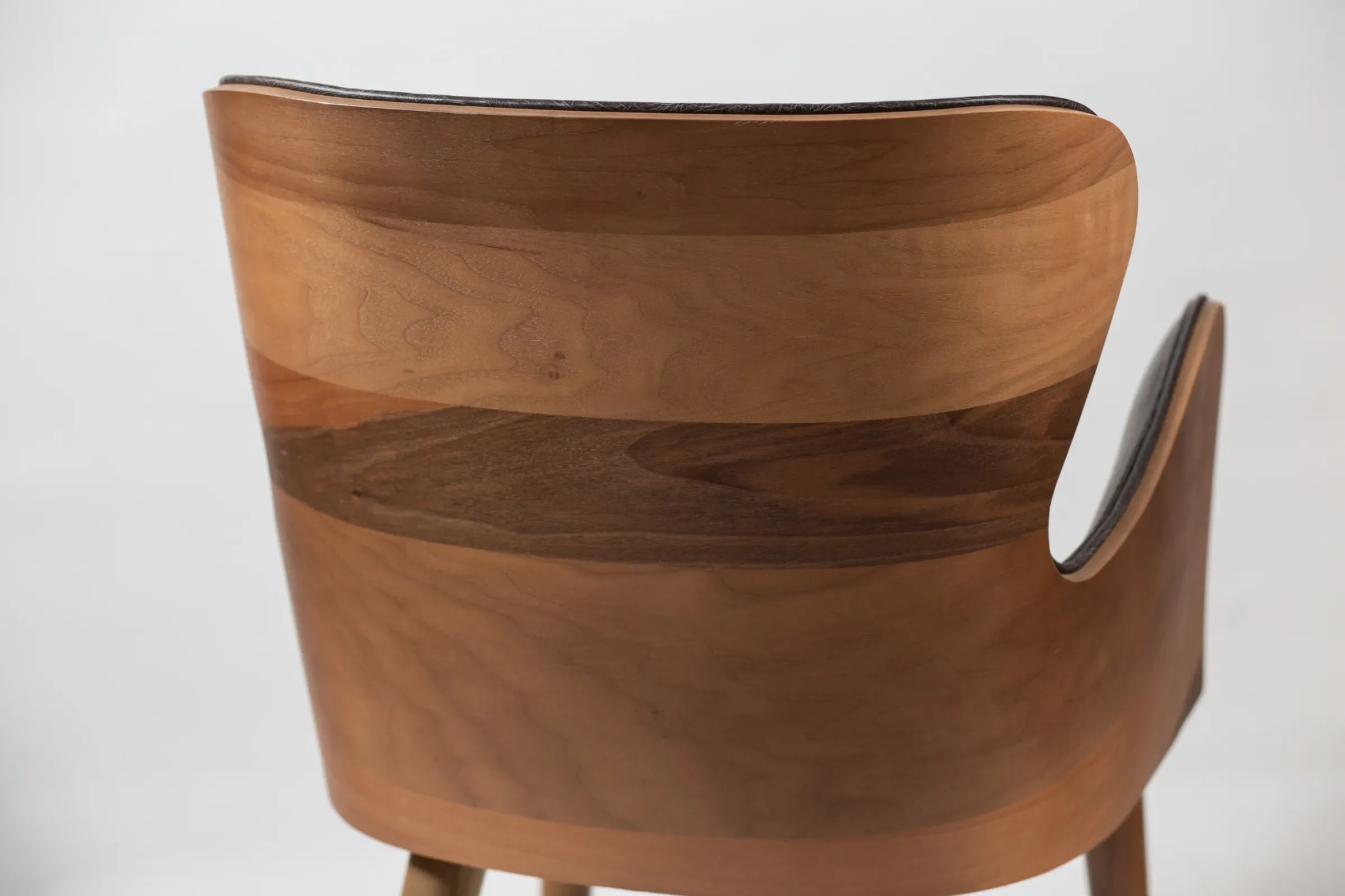
A hard seat wipes clean in seconds. An upholstered one is more comfortable for someone who stays an hour with a laptop, and a thin padded seat sits somewhere between the two. If your customer can't decide, order a sample of each and let them sit on both.
Fabric and foam
Ask what foam is used, how thick it is and how the fabric is fixed to the seat base. Then test the sample against what it will actually meet in a cafe. Coffee and milk are the obvious ones.
Replaceable seats
Ask whether a worn seat can be swapped without replacing the chair. Hospitality customers like this, because a new seat costs less than a new chair.
Backs and arms
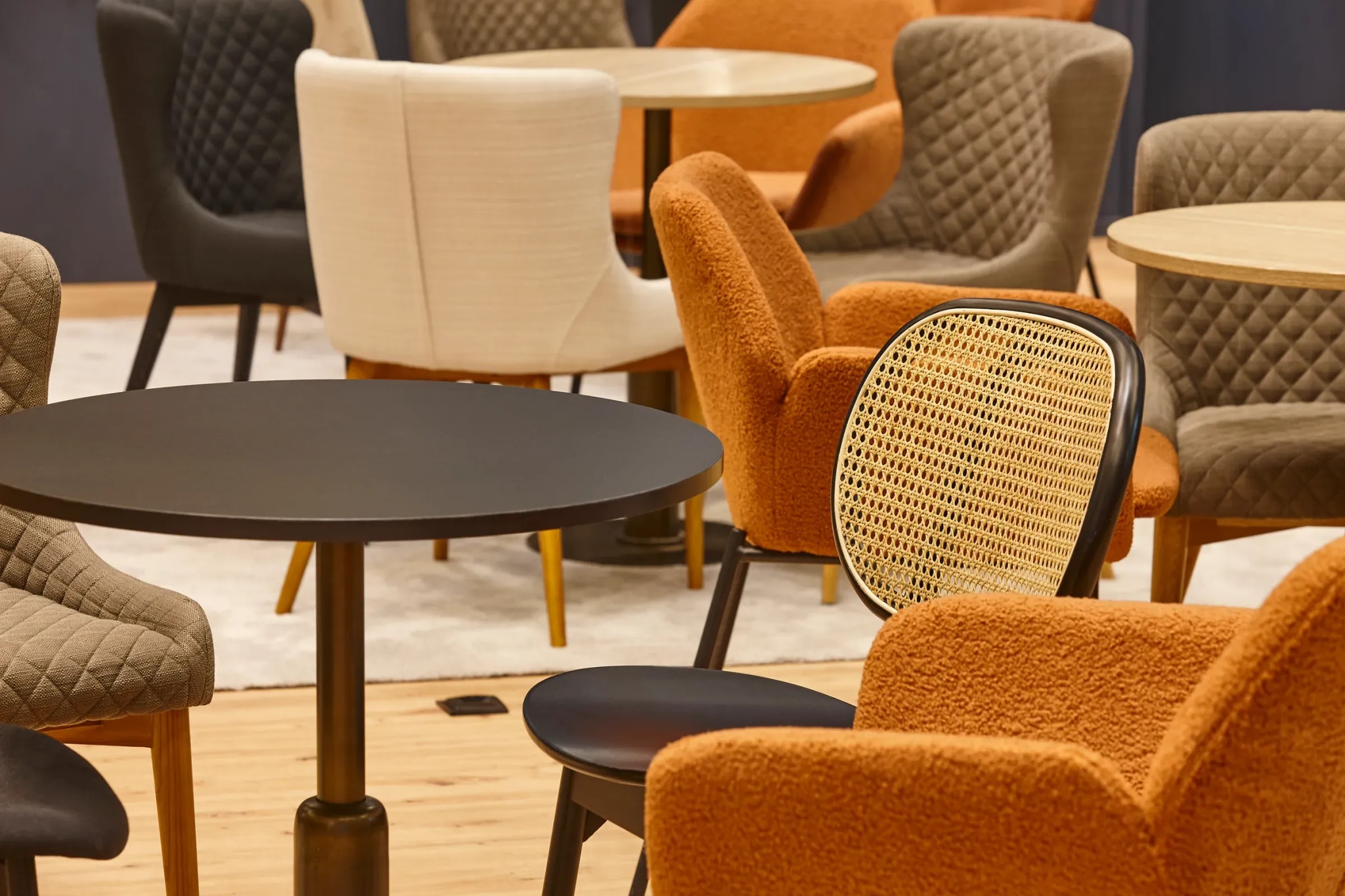
Open backs are easy to clean. Arms are more comfortable, but check that the chair still slides under the table you're pairing it with.
Space Planning
Layout, Stacking and Weight
Seat height, stacking, weight and floor space.
Seat height and table match
Seat height and table height have to work together. Get the dimensions for every model you're considering and check them against your customer's tables. If you're supplying the tables as well, ours start at 50 pcs, so chairs and tables can go in the same order.
Stacking and storage
If the chairs are cleared at night or the room gets set up for events, ask whether the model stacks, how high it stacks safely and whether stacking scuffs the finish.
Weight and handling
Staff move these chairs all day. A lighter chair is easier to handle, but it still has to pass the strength tests, so ask for the net weight and weigh it up against how the chair will be used.
Footprint
Small cafes are tight on space. Check the width and depth of the chair and leave room for someone to pull it out and sit down.
Compliance
Standards and Compliance
What to ask for, and who to check it with.
EN 16139
EN 16139 is the European standard for seating used outside the home. It covers strength, durability and stability, and it grades seating by how heavily it will be used, so ask which level a report covers. The report should be for the exact model you're buying. Look at the edition of the standard, the lab and the date. The standard has been revised, so an older report may not reflect the current version.
UK fire safety
If you sell upholstered chairs in the UK, check the fire-safety rules for your market. They're different for domestic and contract use, so ask your compliance adviser to confirm what applies.
EUDR for wood-frame chairs
From 30 December 2026, the EU Deforestation Regulation is due to apply to wood products placed on the EU market. Treat wood-frame chairs and chairs with plywood parts as in scope unless your customs broker tells you otherwise. You file the due diligence statement, and the factory gives you the data behind it. The date has moved before, so check it. Our post on EUDR for furniture importers lists the data to ask for.
Terms
Ordering Terms
MOQ, lead time, payment and samples.
MOQ, lead time and payment
For dining chairs our MOQ is 100 pcs, and tables and coffee tables start at 50 pcs. Production takes 45 to 60 days. We ask for a 30% T/T deposit, and the balance is due within 10 days against a copy of the BL. Whoever you buy from, ask when the lead time actually starts. Is it the deposit, sample approval or fabric confirmation?
OEM or ODM
With OEM, we build to your drawings. With ODM, you pick a chair from our range and we adapt it. For a first cafe order ODM is usually quicker, because the chair is already in production. You can usually change the fabric, leg finish, dimensions and branding. Get every change in writing.
Sample first
Order a sample in the fabric and finish you want. Sit on it, wipe it, stack it if that matters, and approve it in writing. That sample becomes the reference for the production run. Samples are available, and we reply to enquiries within 24 hours.
Checklist
How to Choose Cafe Chairs for a Wholesale Order
Six things to check with every factory you're comparing.
- Know the venue. How long do people sit, how are the chairs cleaned, and are they stacked at night?
- Pick the frame and seat. Metal or wood; hard, padded or upholstered. Decide before you compare prices.
- Check the fit. Get dimensions, seat height, weight and stacking details, and compare them with your customer's tables.
- Ask for the test report. It should be an EN 16139 report for the exact model, with the edition, lab and date on it.
- Check the wood rules. For wood or plywood models going to the EU, ask what species and origin data the factory can provide.
- Put it all in the quotation. MOQ, lead time, payment and the approved sample should be in writing.
Browse our wholesale dining chairs, check the FAQ for MOQ, lead time and payment, or read about our quality control and OEM/ODM services.
FAQ
Frequently Asked Questions
Quick answers on terms, testing and EU rules.
What is the MOQ for cafe chairs?
100 pcs for dining chairs. Tables and coffee tables start at 50 pcs. We confirm the MOQ for each model in the quotation.
How long does production take, and how do I pay?
Production takes 45 to 60 days. We take a 30% T/T deposit, and the balance is due within 10 days against a copy of the BL.
Which standard should cafe chairs be tested to?
EN 16139, which covers seating used outside the home. Ask for a report on the exact model and check the edition, the lab and the date.
Do wood-frame cafe chairs need EUDR data?
If they're going to the EU, treat them as in scope from 30 December 2026. All-metal chairs are generally outside it. Chairs that mix metal and wood should be checked with your customs broker.
Can I get a sample before ordering?
Yes. Tell us what you need and we'll quote for the sample.
Work With U-LIKE
Planning a Cafe Chair Order?
Send us the chairs you're looking at, the quantity and the destination port. We'll reply within 24 hours with a quote and sample options.