
Extendable Dining Tables: Best Space - Saving Solutions for Small Homes
Author
Ariefin Ariean
Date Published
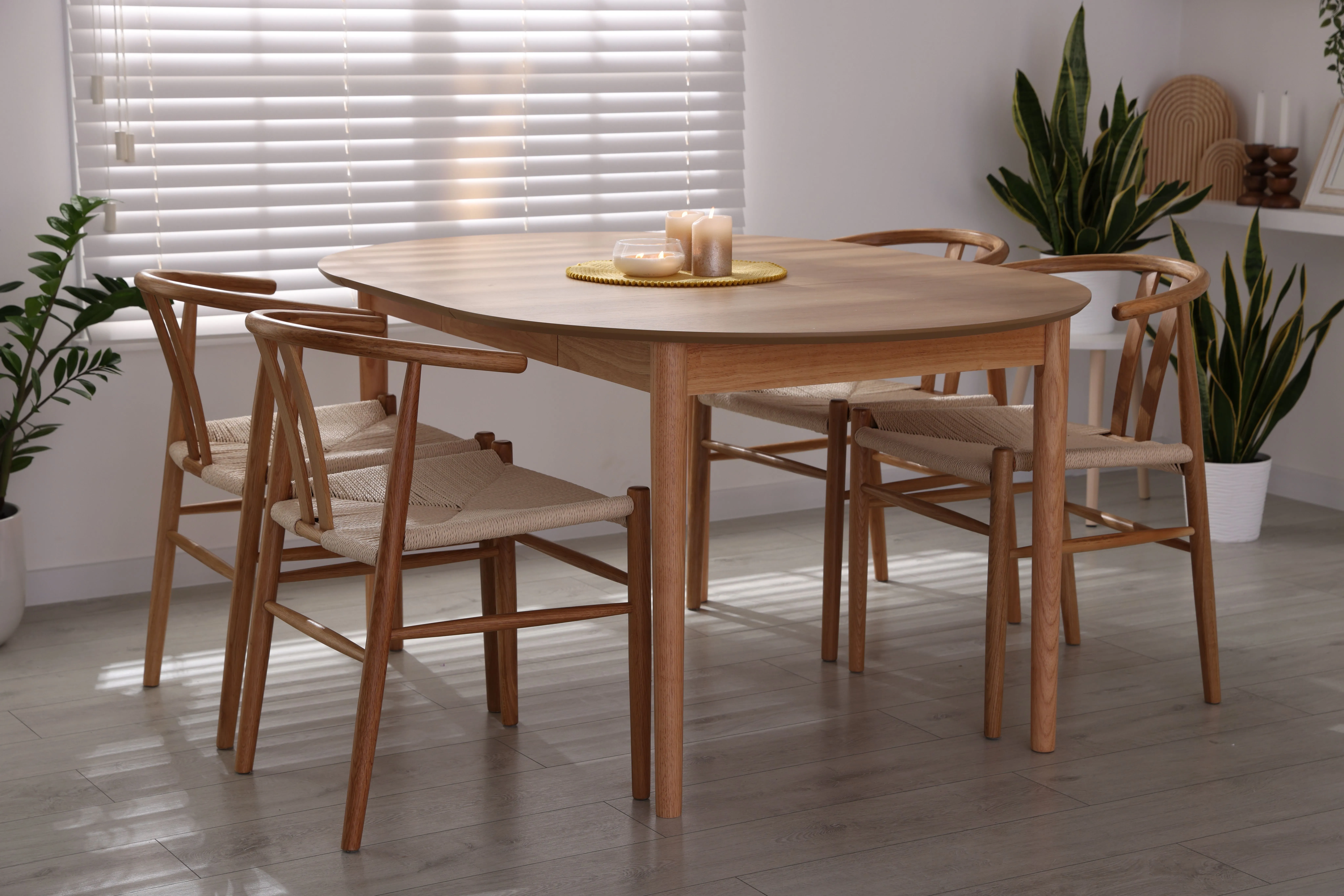
Space efficiency has become an increasingly important consideration across residential development, hospitality, furniture retail, and commercial interiors. As apartments become more compact and dining areas increasingly serve multiple functions, buyers are looking for furniture that can adapt to changing space and usage requirements.
For furniture retailers, wholesalers, distributors, importers, hospitality procurement teams, interior designers, architects, and property developers, extendable dining tables represent a practical product category because they combine everyday footprint efficiency with additional seating capacity when required.
Unlike a conventional fixed dining table, an extendable model can change its usable dimensions through an integrated extension mechanism. That flexibility can make the product relevant across compact residential developments, furnished apartments, hotels, restaurants, cafés, retail collections, and other projects where floor-space utilization matters.
For B2B buyers, however, selecting an extendable dining table is not simply a question of appearance. Product construction, extension hardware, material performance, packaging, dimensions, assembly, quality control, supplier reliability, and commercial positioning all influence the success of a sourcing decision.
This guide explains what professional buyers should evaluate when sourcing extendable dining tables, how different mechanisms compare, which applications they suit, and what to look for in a reliable dining table manufacturer or supplier.
What Are Extendable Dining Tables?
An extendable dining table is a table designed to increase its usable surface area when additional seating or dining space is required.
The table normally operates in two configurations:
- Compact configuration: the table occupies a smaller footprint for everyday use.
- Extended configuration: one or more additional sections increase the tabletop length or width.
The extension can be achieved through several mechanisms, including butterfly leaves, sliding systems, pull-out sections, drop-leaf construction, folding mechanisms, or other integrated hardware.
For B2B buyers, the important distinction is that an extendable table is not simply a smaller table with removable components. The extension system becomes a critical part of the product's engineering, user experience, durability, and quality consistency.
A well-designed system should allow the table to move between configurations with controlled movement while maintaining acceptable alignment and stability.
The commercial value comes from this flexibility. A retailer can offer customers a table that occupies less space during everyday use but accommodates more people when required. A hospitality operator can use the same principle to support different seating configurations. A property developer can specify furniture that works within compact floor plans without sacrificing functionality.
Ulike Furniture currently lists the Ryder Extension Dining Table, featuring an oval tabletop, ceramic surface over engineered wood, a pedestal base, and a hidden extension system designed to accommodate additional seating. Ulike describes the model as suitable for residential projects, apartments, and hospitality environments.
Why Extendable Dining Tables Are an Important B2B Furniture Opportunity
The commercial opportunity for extendable dining tables is closely connected to a broader shift toward flexible and multifunctional interiors.
Furniture Today reported in 2026 that dining collections are increasingly being developed around versatility and a wider range of everyday uses, while flexible table sizes can help accommodate changing dining and living patterns.
InteriorDaily similarly reported in 2026 that hybrid living, smaller urban homes, and changing patterns of work and leisure are supporting greater interest in adaptable and multifunctional furniture, including extendable tables.
For B2B buyers, this creates several potential advantages.
Space Optimization
A smaller table footprint can be valuable in apartments, serviced residences, hospitality rooms, cafés, and other environments where floor space has a direct commercial or functional value.
Flexible Seating
An extendable table can support different seating requirements without requiring a permanently large tabletop.
Product Differentiation
For retailers and e-commerce furniture brands, extension functionality provides an additional product feature that can differentiate an assortment from conventional fixed tables.
Multiple Applications
One product category can serve residential retail, apartment projects, hospitality environments, dining spaces, and selected commercial applications.
Product Positioning
Depending on materials, construction, design, and finish, extendable dining tables can be positioned across mid-market, premium, contemporary, or project-oriented collections.
Retail Merchandising Potential
Retailers can demonstrate the compact and extended configurations visually, making the functionality easier for customers to understand.
The key point for buyers is that the value of an extendable table should be evaluated at both the product level and assortment level. A table may be attractive individually, but its commercial value becomes stronger when its dimensions, price position, packaging, finishes, and target applications fit the buyer's broader furniture portfolio.
Key Applications for Extendable Dining Tables
Extendable Dining Tables for Hotels
Hotels and hospitality properties frequently need furniture that balances design, durability, maintenance, and efficient use of space.
Potential applications include:
- Guest apartments
- Extended-stay accommodation
- Suites
- Serviced apartments
- Dining areas
- Private dining areas
- Flexible hospitality spaces
In smaller guest accommodation, an adaptable dining table can help maintain usable floor area while still allowing additional seating when required.
For hotel procurement teams, the evaluation should extend beyond visual appearance. Important considerations include surface cleanability, structural stability, extension-system durability, replacement availability, finish consistency, packaging, installation, and repeat-order consistency.
Commercial furniture buyers should also establish the intended usage conditions before selecting a product. A table designed primarily for residential use should not automatically be treated as contract-grade furniture.
Extendable Dining Tables for Restaurants and Cafés
Restaurants and cafés operate in environments where space utilization can directly influence seating layouts and customer flow.
An extendable table can potentially support:
- Flexible seating configurations
- Private dining
- Group reservations
- Multi-purpose areas
- Seasonal layouts
- Compact dining zones
For restaurants, however, flexibility must be balanced against operational simplicity.
Procurement teams should evaluate:
- How frequently the extension will be operated
- Whether staff can operate it efficiently
- Whether the mechanism remains stable after repeated use
- How easily the surface can be cleaned
- Whether the extended configuration maintains appropriate clearance
- Whether the table can be moved or stored efficiently
For higher-traffic environments, buyers should request appropriate performance documentation and testing information from the supplier rather than relying solely on marketing terminology such as "commercial grade."
BIFMA's standards framework illustrates why this distinction matters: commercial furniture standards address areas including safety, durability, structural performance, and sustainability, while ANSI/BIFMA X5.5 specifically covers desk and table products intended for commercial, institutional, educational, retail, restaurant, and cafeteria environments.
Extendable Dining Tables for Serviced Apartments
Serviced apartments frequently require furniture that supports several uses within a relatively limited footprint.
An extendable table can provide a compact everyday configuration while offering additional capacity for guests, meals, work, or social activities.
For buyers furnishing multiple units, consistency becomes particularly important. The procurement specification should establish:
- Standard dimensions
- Finish
- Hardware
- Surface material
- Extension configuration
- Assembly requirements
- Packaging
- Replacement requirements
A standardized product can also simplify purchasing and maintenance across multiple properties.
Extendable Dining Tables for Property Developers
Property developers can consider extendable dining tables for:
- Compact apartments
- Furnished apartments
- Build-to-rent developments
- Serviced residences
- Show apartments
- Residential furnishing packages
For developers, space efficiency should be evaluated alongside procurement practicality.
A product that saves floor space but has complex assembly, difficult maintenance, inconsistent finishes, or poor packaging may not deliver the expected lifecycle value.
The strongest specification considers the complete product lifecycle:
Design → sourcing → delivery → installation → daily use → maintenance → replacement.
Extendable Dining Tables for Furniture Retailers
Retailers can use extendable dining tables as a way to diversify a dining furniture assortment.
Potential advantages include:
- Product differentiation
- Multiple seating configurations
- Higher feature visibility
- Cross-selling opportunities
- Premium positioning
- Compact display potential
- Strong visual merchandising opportunities
Retailers should consider showing both configurations in product photography and showroom displays.
For e-commerce retailers, this is particularly important. Product pages should clearly communicate:
- Closed dimensions
- Extended dimensions
- Table height
- Extension capacity
- Extension mechanism
- Materials
- Finish
- Assembly requirements
- Packaging information
- Recommended seating capacity
Customers cannot physically inspect an online product, so incomplete dimensions or unclear extension instructions can increase purchase uncertainty and potentially contribute to returns.
Extendable Dining Tables for Wholesalers and Distributors
For wholesalers and distributors, the evaluation shifts toward assortment economics and supply-chain efficiency.
Important considerations include:
- SKU structure
- Available finishes
- Product dimensions
- Carton dimensions
- Packaging efficiency
- Container utilization
- Assembly requirements
- Replacement parts
- Lead times
- Minimum order quantities
- Repeat-order consistency
A distributor should also determine whether the product fits an existing assortment rather than evaluating it in isolation.
For example, an extendable dining table may have stronger commercial potential if it can be paired with complementary dining chairs, benches, sideboards, or other products within the same design language.
Extendable Dining Tables for Interior Designers and Architects
Designers and architects typically evaluate dining furniture from both aesthetic and specification perspectives.
Key considerations include:
- Proportion
- Circulation
- Material coordination
- Finish compatibility
- Seating configuration
- Room dimensions
- Project durability requirements
- Maintenance
- Installation
- Product consistency
For hospitality and residential projects, designers should obtain accurate technical drawings and dimensions before final specification.
Types of Extendable Dining Tables Buyers Should Know
Different extension mechanisms offer different combinations of functionality, construction complexity, cost, and commercial suitability.
| Type | Mechanism | Key Advantage | Main Consideration | Typical B2B Applications |
|---|---|---|---|---|
| Butterfly-leaf | Leaf folds and stores within the table | Convenient self-storage | Hardware quality and alignment | Retail, residential, apartments |
| Drop-leaf | Hinged sections fold down | Very compact footprint | Reduced usable surface when folded | Small apartments, compact retail |
| Pull-out extension | Table sections pull apart and reveal extension | Intuitive operation | Rail and hardware durability | Residential, hospitality |
| Slide-extension | Sections slide along integrated rails | Smooth configuration change | Mechanism precision | Mid-market and premium furniture |
| Self-storing extension | Extension sections remain integrated | Reduces lost components | More complex construction | Retail and residential |
| Folding table | Sections fold or collapse | High space efficiency | Stability and commercial durability | Compact spaces, flexible environments |
| Console-to-dining | Compact console expands into dining table | Extremely flexible footprint | Higher mechanical complexity | Apartments, space-saving retail |
| Other integrated mechanisms | Varies by design | Allows product differentiation | Requires detailed technical evaluation | Custom and specialized projects |
No single mechanism is universally superior.
The correct choice depends on the target market, frequency of use, desired price position, available space, packaging requirements, and expected durability.
Materials and Construction for Extendable Dining Tables
Material selection affects not only appearance but also product weight, surface performance, packaging, shipping, cost, and perceived value.
Solid Wood
Solid wood can support premium positioning and offers natural material appeal.
B2B buyers should evaluate:
- Wood species
- Moisture control
- Construction method
- Joint quality
- Dimensional stability
- Finish consistency
- Weight
Solid wood can also increase product weight and shipping considerations.
Engineered Wood
Engineered wood can provide dimensional consistency and design flexibility.
For buyers, relevant factors include:
- Board specification
- Thickness
- Edge treatment
- Surface finish
- Hardware integration
- Moisture resistance
- Quality consistency
MDF
MDF is widely used in contemporary furniture because it can provide a consistent substrate for various surface treatments.
Ulike's current dining-table category lists multiple products using MDF, while its Ryder extension table specifies an engineered-wood/ceramic construction and identifies MDF in its product details.
Veneer
Veneer can create a natural-wood appearance while using an engineered substrate.
Buyers should examine:
- Veneer quality
- Grain matching
- Edge treatment
- Finish consistency
- Repairability
Laminate
Laminate surfaces can be practical where resistance to everyday wear and ease of maintenance are important.
The exact performance depends on the laminate system and substrate, so buyers should request technical specifications rather than assuming all laminate surfaces perform identically.
Metal
Metal may be used in bases, frames, extension components, or structural elements.
Important factors include:
- Gauge
- Welding quality
- Coating
- Corrosion resistance
- Connection method
- Structural stability
Glass
Glass can support a contemporary appearance but requires careful consideration of weight, handling, packaging, edge treatment, safety, and cleaning.
Mixed Materials
Mixed-material construction can combine visual appeal with specific performance characteristics. Examples include engineered wood with ceramic surfaces, wood-look finishes with metal structures, or composite tops with timber bases.
The appropriate combination depends on the intended market and usage environment.
How Buyers Should Evaluate an Extendable Dining Table
A professional sourcing evaluation should cover five major areas: product, construction, commercial performance, logistics, and supplier capability.
1. Product Design
Evaluate:
- Market appeal
- Design language
- Dimensions
- Closed configuration
- Extended configuration
- Seating capacity
- Ergonomics
- Compatibility with dining chairs
A table should make sense within the target market's existing furniture assortment.
2. Construction
Inspect:
- Frame construction
- Base structure
- Joints
- Extension rails
- Hinges
- Locks
- Support mechanisms
- Fasteners
- Stability
The extension mechanism deserves particular attention because it introduces moving components that a fixed table does not require.
3. Materials
Confirm:
- Tabletop material
- Substrate
- Edge construction
- Frame material
- Finish
- Hardware
- Adhesives where relevant
Ask the supplier for precise specifications rather than relying on generic descriptions.
4. Quality
A procurement inspection should assess:
- Surface consistency
- Color consistency
- Edge quality
- Alignment
- Gaps
- Hardware operation
- Table stability
- Extension smoothness
- Finish defects
For commercial projects, establish acceptance criteria before production.
5. Logistics
Request:
- Product dimensions
- Packed dimensions
- Gross weight
- Net weight
- Carton specification
- Number of cartons
- Assembly instructions
- Packaging photographs
- Loading information
Packaging should protect the product without creating unnecessary shipping inefficiency.
6. Supplier Capability
Evaluate:
- Production capacity
- Quality control
- Product development
- Lead times
- Communication
- Technical documentation
- Sampling
- Repeat-order consistency
- Customization capability
- Export processes
A reliable supplier should be evaluated as a long-term supply-chain partner, not simply as the lowest quotation.
Extendable Dining Tables vs. Fixed Dining Tables
| Factor | Extendable Dining Table | Fixed Dining Table |
|---|---|---|
| Space efficiency | High flexibility between configurations | Depends entirely on fixed dimensions |
| Seating flexibility | High | Fixed |
| Product differentiation | Strong feature-based differentiation | More dependent on design/materials |
| Retail appeal | Strong where flexibility is valued | Strong for simpler product propositions |
| Hospitality applications | Useful where layouts change | Useful for standardized layouts |
| Commercial applications | Suitable when flexibility is required | Suitable for consistent layouts |
| Maintenance | More components may require inspection | Generally simpler |
| Construction complexity | Higher due to extension mechanism | Usually lower |
| Customer use cases | Multiple seating configurations | More predictable daily setup |
| Product positioning | Can support feature-led or premium positioning | Broad range of price and design positions |
When Extendable Tables Make More Sense
They are particularly relevant when:
- Space is limited.
- Seating requirements vary.
- The room has multiple uses.
- Product differentiation is important.
- Customers value flexibility.
- The buyer wants a compact everyday footprint.
When Fixed Tables Make More Sense
Fixed tables may be preferable when:
- The layout is standardized.
- The table will rarely change configuration.
- Simplicity is the priority.
- Lowest mechanical complexity is preferred.
- The project requires consistent dimensions throughout.
The correct decision depends on the intended operating environment rather than the assumption that extendable tables are always better.
What Makes a Good Extendable Dining Table Supplier?
Selecting an extendable dining table supplier requires more than reviewing a product catalog.
A strong supplier evaluation should cover the following.
Manufacturing Consistency
Can the supplier reproduce the same dimensions, finish, hardware, and construction across repeat orders?
Quality Control
Does the supplier inspect raw materials, production stages, finished goods, and packaging?
Product Development
Can the supplier develop products that respond to changing market requirements?
Extension Mechanism Quality
Does the supplier understand the mechanical requirements of extension systems and maintain consistent operation?
Material Sourcing
Can the supplier maintain stable material specifications across production runs?
Production Capacity
Can the supplier support the required order volume without compromising consistency?
Packaging
Are products protected against common shipping risks?
Documentation
Can the supplier provide technical information, dimensions, specifications, product images, and other documentation required by the buyer?
Sampling
Can buyers evaluate a sample before committing to larger production?
Lead Times
Are production schedules clearly communicated and realistically managed?
Communication
Does the supplier provide clear answers regarding specifications, pricing, production, quality, and shipping?
Long-Term Reliability
The most useful supplier relationship is one that can support repeat purchasing rather than a single transaction.
Questions B2B Buyers Should Ask Before Placing an Order
Before ordering extendable dining tables, procurement teams should ask:
- What materials are used for the tabletop and frame?
- What extension mechanism is used?
- How many extension cycles has the mechanism been tested for?
- What are the closed and extended dimensions?
- What is the recommended seating capacity?
- What is the table's net and gross weight?
- What are the packed dimensions?
- How is the table packaged?
- What assembly is required?
- What finishes are available?
- Are samples available?
- Can the product be customized?
- What are the applicable MOQ requirements?
- What is the estimated production lead time?
- What quality-control process is followed?
- Are test reports or compliance documents available where required?
- What spare or replacement components are available?
- What after-sales support is provided?
- What shipping and delivery options are available?
- Can the supplier maintain consistent specifications for repeat orders?
For any specific service, including customization, sampling, MOQ, testing, documentation, or project support, buyers should confirm current availability and commercial terms directly with the supplier.
Extendable Dining Tables for Furniture Retailers
Retail buyers should evaluate extendable dining tables as part of a complete assortment rather than as isolated products.
Product Assortment
A balanced dining range may include:
- Fixed dining tables
- Extendable dining tables
- Round tables
- Rectangular tables
- Dining chairs
- Armchairs
- Benches
- Complementary storage
This allows the retailer to address different space, design, and price requirements.
Price Positioning
Retailers should define whether the product belongs to:
- Entry-level
- Value
- Mid-market
- Premium
- Design-led
The extension mechanism, materials, finish, construction, packaging, and overall design can all affect the product's positioning.
Display Strategy
A showroom should ideally communicate both configurations.
If customers only see the table in its compact configuration, they may not understand its principal functional benefit.
Online Merchandising
Online retailers should make the extension feature highly visible.
Recommended product-page information includes:
Closed size → Extended size → Extension method → Seating capacity → Material → Finish → Assembly → Packaging.
Clear photography should show the transition between configurations.
Cross-Selling
Extendable dining tables can also create opportunities to sell:
- Dining chairs
- Armchairs
- Benches
- Sideboards
- Cabinets
- Dining accessories
A coordinated collection can increase the commercial value of the product category.
Extendable Dining Tables for Hospitality Projects
Hospitality buyers should evaluate an extendable table according to actual operational requirements.
For hotels, restaurants, cafés, and serviced apartments, the procurement specification should cover:
Durability
Determine expected usage frequency and establish appropriate performance requirements.
Cleaning
Select surfaces and finishes compatible with the property's cleaning procedures. BIFMA's 2026 G8.1 guideline demonstrates the industry's increasing attention to furniture-surface performance in cleaning, sanitizing, and disinfecting environments, including commercial settings.
Space Utilization
Assess both the compact and extended configurations against actual floor plans.
Design Consistency
For multi-unit projects, maintain consistent dimensions, colors, finishes, and hardware.
Project Quantities
Confirm production capacity and delivery schedules before approving large project quantities.
Replacement Requirements
Ask whether replacement components, hardware, or additional units can be supplied later.
Extendable Dining Tables for Property Developers
For property developers, furniture selection should support both the design concept and procurement model.
Extendable dining tables can be considered for:
- Compact apartments
- Furnished residential developments
- Build-to-rent properties
- Serviced residences
- Show apartments
- Rental furnishing packages
The central question is not simply whether the table fits the room.
The procurement team should ask:
Does the product improve space utilization without creating disproportionate complexity, cost, or maintenance requirements?
For projects involving hundreds of units, even small differences in packaging, assembly time, dimensions, and replacement requirements can affect the overall project process.
Trends in Extendable Dining Tables for 2026
Several 2026 furniture trends are relevant to the extendable dining table category.
Multifunctional Furniture
Multifunctionality continues to influence furniture design as spaces accommodate more activities.
InteriorDaily's 2026 reporting identifies adaptability and multifunctional furniture as important responses to changing lifestyles and smaller urban homes.
Flexible Living
Furniture is increasingly expected to support changing room functions rather than one fixed use.
An extendable dining table fits this principle because its footprint can change according to the user's requirements.
Space Efficiency
Space-saving remains commercially relevant in compact residential environments. The opportunity is particularly clear where dining areas overlap with kitchens, living spaces, work areas, or other functions.
Warm Contemporary Design
Furniture Today reported in 2026 that dining buyers are responding to versatile products and broader design flexibility, while dining environments increasingly combine everyday utility with visual impact.
Modular and Adaptable Products
2026 trend coverage also highlights modular, portable, and adaptable furniture as designers respond to changing work, living, and mobility patterns.
Better Commercial Performance Expectations
Commercial buyers are increasingly focused not just on appearance but on cleanability, durability, performance, and documented suitability.
BIFMA's ongoing standards development and its 2026 furniture-surface guideline reflect this broader emphasis on measurable furniture performance.
For manufacturers and buyers, the implication is straightforward: future dining furniture must increasingly combine design flexibility with measurable product performance.
Explore Ulike Furniture Dining Tables
Why B2B Buyers Should Consider Space-Saving Dining Furniture
Extendable dining tables are not simply a solution for small homes. They represent a broader furniture strategy centered on flexibility.
For professional buyers, potential commercial benefits include:
- Expanding a dining furniture assortment
- Addressing compact-space markets
- Offering flexible seating
- Supporting hospitality applications
- Creating product differentiation
- Serving multiple project types
- Supporting premium or feature-led positioning
- Responding to changing furniture requirements
However, flexibility should never replace proper product evaluation.
A successful sourcing decision requires the right balance between design, functionality, durability, price, logistics, supplier capability, and target-market requirements.
B2B Buying Checklist for Extendable Dining Tables
Product
- Design matches target market
- Closed dimensions confirmed
- Extended dimensions confirmed
- Seating capacity confirmed
- Materials documented
- Extension mechanism identified
- Finish specified
- Durability requirements established
- Assembly requirements confirmed
Supplier
- Manufacturing capability evaluated
- Quality-control process reviewed
- Production consistency verified
- Lead time confirmed
- Communication process established
- Technical documentation available
- Sample evaluated
- Repeat-order requirements discussed
- Customization availability confirmed where required
Commercial
- Target market identified
- Price position established
- Expected margin evaluated
- Retail potential assessed
- Hospitality suitability assessed
- Project suitability assessed
- Product assortment fit reviewed
Logistics
- Carton dimensions confirmed
- Gross weight confirmed
- Packaging specification reviewed
- Shipping requirements evaluated
- Assembly instructions confirmed
- Storage requirements assessed
- Replacement-part process discussed
Frequently Asked Questions About Extendable Dining Tables for B2B Buyers
1. What should furniture retailers look for in an extendable dining table?
Retailers should evaluate design appeal, closed and extended dimensions, mechanism quality, materials, finish, seating capacity, packaging, assembly, price positioning, and supplier consistency.
2. How do I choose an extendable dining table supplier?
Compare manufacturing capability, product quality, extension mechanisms, documentation, sampling, production lead times, MOQ, packaging, communication, customization options, and long-term supply reliability.
3. What makes a good dining table manufacturer?
A strong dining table manufacturer should demonstrate consistent production, controlled materials, reliable construction, quality-control procedures, technical documentation, product development capability, and dependable order management.
4. Are extendable dining tables suitable for hotels?
They can be suitable for hotels, serviced apartments, and other hospitality applications when the product meets the property's durability, maintenance, space, design, and project requirements.
5. Are extendable dining tables suitable for restaurants?
They can be useful where seating configurations change. Restaurant buyers should specifically evaluate extension frequency, mechanism durability, cleaning requirements, stability, and operational practicality.
6. What materials are best for commercial dining tables?
There is no universally best material. The correct choice depends on the intended environment, durability requirements, maintenance, weight, aesthetics, packaging, price position, and project specifications.
7. How durable are extendable dining tables?
Durability depends on construction, materials, hardware, extension mechanism, manufacturing quality, and usage conditions. Buyers should request relevant test information rather than relying on generic durability claims.
8. What should wholesalers consider when sourcing dining tables?
Wholesalers should consider SKU structure, dimensions, packaging, container efficiency, price positioning, finish options, minimum order quantities, lead times, repeat-order consistency, and market demand.
9. What should I ask a furniture manufacturer before ordering?
Ask about materials, construction, extension hardware, dimensions, packaging, MOQ, lead time, quality control, samples, customization, testing, documentation, shipping, and after-sales support.
10. Are extendable dining tables suitable for small apartments?
Yes. Their primary advantage is that they can provide a smaller everyday footprint while offering additional surface area when required.
11. What are the advantages of buying dining tables wholesale?
Wholesale sourcing can help retailers, distributors, and project buyers build a consistent product assortment and plan larger-volume procurement. Commercial terms should be evaluated alongside quality and supplier reliability.
12. How do furniture retailers choose dining table suppliers?
Retailers typically need to assess product design, quality, price position, packaging, documentation, availability, lead times, product assortment, and the supplier's ability to support repeat orders.
13. What is the difference between an extendable and fixed dining table?
A fixed table has a permanent tabletop size, while an extendable dining table incorporates a mechanism that allows its usable dimensions to increase.
14. How should commercial furniture buyers evaluate table quality?
Evaluate materials, construction, stability, hardware, surface finish, extension operation, dimensional consistency, testing information, and the product's suitability for the intended usage environment.
15. What packaging requirements should furniture buyers consider?
Buyers should review carton dimensions, protective materials, gross weight, assembly configuration, edge protection, internal supports, shipping efficiency, and damage-prevention measures.
16. What should property developers consider when sourcing dining furniture?
Developers should consider design consistency, dimensions, project quantities, space efficiency, price, durability, delivery schedules, installation, packaging, maintenance, and replacement requirements.
17. How can restaurants optimize space with extendable dining tables?
Restaurants can use extendable tables to support different seating arrangements, private dining, group bookings, and changing layouts where the product's dimensions and mechanism are appropriate for the operating environment.
18. What should interior designers consider when specifying dining tables?
Designers should evaluate proportion, circulation, materials, finishes, dimensions, seating, extension configuration, maintenance, durability, project standards, and coordination with the overall interior concept.
19. What should e-commerce furniture retailers show on an extendable table product page?
At minimum, show closed and extended dimensions, product photographs in both configurations, materials, finish, seating capacity, extension mechanism, assembly requirements, weight, and relevant packaging information.
20. Can an extendable dining table be customized for a B2B project?
Some manufacturers offer customization or OEM/ODM services, but availability depends on the supplier and product. Buyers should confirm customization scope, development requirements, MOQ, sampling, lead time, and commercial terms before proceeding.
Conclusion: Choosing the Right Extendable Dining Table Supplier
Extendable dining tables address an important requirement in modern furniture procurement: the ability to provide greater functionality without permanently increasing the furniture footprint.
For furniture retailers, wholesalers, distributors, importers, hospitality operators, architects, designers, and property developers, the category can provide a practical combination of space efficiency, flexible seating, product differentiation, and multiple application potential.
But the extension mechanism should never be evaluated in isolation.
The strongest procurement decision considers the entire product:
Design + Construction + Materials + Mechanism + Quality + Logistics + Supplier Capability.
Buyers should compare closed and extended dimensions, assess the intended usage environment, review material and hardware specifications, evaluate packaging, request samples where appropriate, and verify the supplier's ability to maintain quality across repeat orders.
Ulike Furniture currently offers a dedicated dining furniture portfolio and lists the Ryder Extension Dining Table as an example of its flexible dining-table offering. Its B2B model also covers retailers, wholesalers, online marketplaces, hospitality buyers, purchasing agents, designers, architects, and real-estate developers.
For businesses evaluating extendable dining table manufacturers, dining furniture suppliers, or space-saving furniture for retail and project applications, the next step is to compare specific product specifications and discuss the requirements directly with the manufacturer.
